On August 1, Jacob Douenias and Ethan Frier hosted a Coffee Date at the Mattress Factory's satellite gallery at 1414 Monterey Street where their installation "Living Things" occupies the entire first floor. Jacob and Ethan are alumni from Carnegie Mellon University's School of Architecture and School of Design, respectively.
Their installation is set as though you're walking into a home. A seating area equipped with a rug and coffee table greet you as you first enter the room, and a table and black and white tiled floor are positioned at the rear with a desk roped off to the left. Jacob and Ethan choose to host their Coffee Date in their installation, as opposed to the MF Café where previous Coffee Dates are typically held. MF Members were invited to sit down and use the coffee table, as Jacob and Ethan made themselves available to answer questions.
Jacob and Ethan opened up the roped off desk on the left-hand side of the room to demonstrate to MF Members how their installation was operating. It is indeed a "living thing," with the algae growing in the basement of the museum (not on view) and being pumped and siphoned to the glass orbs controlled by a series of white knobs embedded in the wooden desk.
Don't miss our next behind-the-scenes Coffee Date with upcoming artist Marnie Weber on August 15 at 10:30am. Marnie's installation opens as Part II of Factory Installed on September 19.
For more information about Coffee Dates or to become a member, please visit our website at www.mattress.org.
Wednesday, August 12, 2015
Monday, August 10, 2015
RECAP // Mini-Factory: PATTERNS!
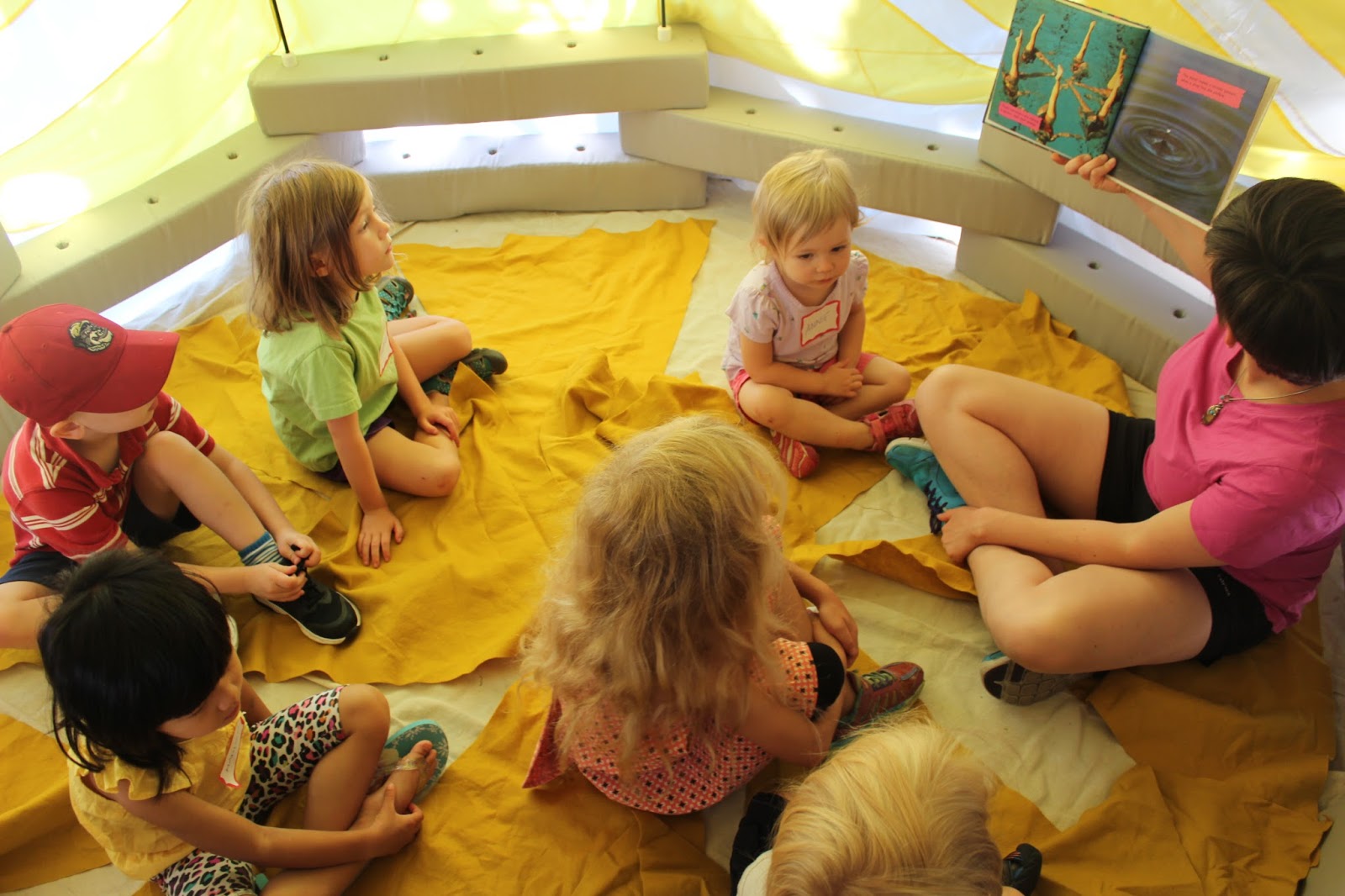
PATTERNS surround us in our world. They can be created using colors, shapes, and different sizes ... on our clothes, dinner plates and sidewalks, PATTERNS allow us to find repetition at its best. Thick, white stripes on a street indicate it is safe to cross. Rows of alternating red rectangles reach up to the sky exemplifying the craftsmanship of a multi-storied building (like the Mattress Factory!). Some artists use PATTERNS to convey feelings, set a mood, or shock our senses. Mini-Factory visited shift lens by Anne Lindberg. Using tightly pulled thread secured to each side of the room, a colorful yet surreal crisscross PATTERN is created. Light filters from the windows behind allowing colors to bend and play with your visual senses. The consensus? ... Very cool!
Yayoi Kusama uses polka-dots throughout her installations so viewers may experience her point of view - literally - and the ensuing feelings. What do you feel when walking through Infinity Dots Mirrored Room and Repetitive Vision? Calm, jolted, dizzy? The abundance of polka-dots plays a large role with how we feel in these installations.
PATTERNS also occur naturally, such as the lines in a blade of grass, the veins of a leaf and the speckles in a piece of granite. Our young artists were given magnifying glasses and asked to walk through Winifred Lutz's Garden in search of patterns. Leaves, bricks, rocks and water were inspected for naturally occurring PATTERNS - success!
Of course given the chance, these energetic artists love to create something new. Using their imagination and inspiration learning and observing PATTERNS, our young crew created their own installations with various materials such as yarn, stickers, markers, pipe cleaners and tape. There were PATTERNS of all kinds; two-toned stripes, colorful polka-dots, sparkling spirals, and more.
Mini-Factory is an interactive learning program for children ages 3-5 years old and their parents or caregivers. Using contemporary installation art, parents and children will explore new ideas and concepts from the everyday world. Join us at 10am on August 22, 2015 to explore the theme of SCIENCE.
Yayoi Kusama uses polka-dots throughout her installations so viewers may experience her point of view - literally - and the ensuing feelings. What do you feel when walking through Infinity Dots Mirrored Room and Repetitive Vision? Calm, jolted, dizzy? The abundance of polka-dots plays a large role with how we feel in these installations.
PATTERNS also occur naturally, such as the lines in a blade of grass, the veins of a leaf and the speckles in a piece of granite. Our young artists were given magnifying glasses and asked to walk through Winifred Lutz's Garden in search of patterns. Leaves, bricks, rocks and water were inspected for naturally occurring PATTERNS - success!
Of course given the chance, these energetic artists love to create something new. Using their imagination and inspiration learning and observing PATTERNS, our young crew created their own installations with various materials such as yarn, stickers, markers, pipe cleaners and tape. There were PATTERNS of all kinds; two-toned stripes, colorful polka-dots, sparkling spirals, and more.
Mini-Factory is an interactive learning program for children ages 3-5 years old and their parents or caregivers. Using contemporary installation art, parents and children will explore new ideas and concepts from the everyday world. Join us at 10am on August 22, 2015 to explore the theme of SCIENCE.
Categories:
Anne Lindberg,
GARDEN,
MINI-FACTORY,
Winifred Lutz,
YAYOI KUSAMA
Monday, August 3, 2015
ANNOUNCING // "Factory Installed" Artist Interviews
Artist interviews for Factory Installed currently on display at the 1414 Monterey Street gallery are now available on the MF SoundCloud page!
Track 5: Anne Lindberg, "Shift Lens"
This round of guides are soundbites taken straight from interviews with the exhibiting artists themselves, and they include a description of each piece as well as bonus commentary that covers a variety of different topics from how the artists created their pieces, to what it was like working at the Mattress Factory, and more. Here is a quick overview of each track and some highlighted quotes from the artists' commentary.
Jacob and Ethan describe their piece as a near future living environment in which a totally functioning bio system made to harvest and cultivate a kind of algae called Spirulina, is integrated into different kinds of furniture in a home environment.
Jacob Douenias: "...even now the first reaction when you talk to people about algae is they think of scum, the goopy pond stuff... Most people's first impression is not great, so with this piece it is a proof of concept, that this can be beautiful. Leaving aside the functionality, it could be a resource-efficient way of providing a supplementary nutrient, fuel and doing these things in a way so they don't take up extra space."
Track 2: [Bonus Commentary]
Jacob and Ethan tell us about their backgrounds in architecture and industrial design, and their unusual transition into installation art and how it's freed up their process.
Ethan Frier: "I've (always) wanted to make something that is more art, but I'm a designer... How do I make this thing practical? I've kind of realized that art and design - there is a very fluid border between them... There is art in everything and design in everything. I think working as an artist has freed up my design process a lot more because I feel more comfortable to go outside the bounds of what the profession is perceived to be."
Julie Schenkelberg describes the process of collecting materials from the area where she's building, the kinds of objects she collects and why, and the story that she's trying to tell in her work.
"Sometimes I explain my pieces as if they are tattered manuals and pieces are discarded or missing and then we have these objects in front of us that we're unsure how to operate. So I operate them the way that I would imagine and therefore pieces of molding become structure for the room. Dishes become pieces that support a chair... You walk in and it's completely chaotic and it is totally blended together as the same symphony and it becomes this quiet moment."
Track 4: [Bonus Commentary]
Julie talks about how she always thought she had a story to tell, and the lonely path she followed for a while after quitting theatre and trying to find a way to tell her story as a different kind of artist.
"It just sort of happened. I stopped painting and started touching objects, using objects and then a wise person told me I couldn't deny my theatre history. So the paintings came off the wall with objects and then it just started cascading onto the floor and up to the ceiling - that was a moment when it just took over. And it just kept taking over."
Anne Lindberg describes the intricate process involved in creating her piece and the performative quality that can only be carried out while working on-site at the Mattress Factory.
"So the piece is comprised of hundreds of lines of cotton thread that are held taught between two walls in the space and then between the floor and the upper edge of the bay window... In terms of a process, the lines that make up the work are stitched or threaded back and forth between the walls as if you are stitching the architecture. There is a person at each wall wielding a staple gun and there is a runner or perhaps one of us stepping down and moving the thread so it is a performance of sorts when it is being made."
Track 6: [Bonus Commentary]
Anne talks about how the history of the space in which she creates her work influences the way she designs and creates them, and how the Mattress Factory's willingness to give her the freedom to alter the space as much as she wishes is a truly unique experience as an artist.
"I try to visit the space and... look at it in a very diagrammatic way as well as a more human way. Who are the visitors? What is the history of the building? How will that tell me how to form the work? ...The thing I come away with is that it seems like anything is possible here. In a quite literal way I've been allowed to staple to the floor. That's not possible in 99% of the spaces you're invited to work in... that understanding that a space is a space and it has character and if you want to change it or alter it. That's a real testament to the leadership here... That all those spaces have equal value. And I'll go away with that and remember that."
Track 7: John Morris, "Life, Afterlife"
John Morris tells us about how he integrates everyday objects into his artwork that people may believe are ugly or unappreciated, and through a simple process he allows you to rediscover these objects in a new and beautiful way.
"I think to some extent the goal of the work is... that I would be able to integrate almost anything. Like by peeling, rediscovering the world and maybe appreciating it in a new way... and then learning to integrate these things together in some new way and accepting what they become."
Track 8: [Bonus Commentary]
John tells us about how he got started as an artist by doodling and drawing things and how that relates to his current work, and also how his work has to do with pushing boundaries and definitions of certain kinds of artwork.
"My major thing I'm known for is drawing and a lot of things I'm doing in that installation... there is some sense of drawing. Like doodling, I don't know where it's going... I think there is something about this work that is very much about pushing, you know really pushing boundaries and accepting what other things could be and just not defining it in any way. Is this a drawing? Is this a painting? Is this an installation? When does it begin? When does it end?
The audio guides can be found on the Mattress Factory Soundcloud page, or by clicking one of the two links on the Mattress Factory website's home page (the scrolling banner at the top or the "Listen Now" link on the bottom right). Listen to them at the museum or listen from the comfort of your own home!
Categories:
ANNOUNCING,
Audio Guides,
FACTORY INSTALLED
Thursday, July 16, 2015
RECAP // Factory 500: Lenka Clayton Studio + Clemente Museum Visit
| Factory 500 Member taking a closer look at Lenka's Typewriter Drawings |
At the most recent outing for the MF's Factory 500 program, members got a special glimpse into some one-of-a-kind places in Pittsburgh. The first stop was at the studio of Lenka Clayton, a British conceptual artist now living and working in Pittsburgh. Named the 2013 emerging artist of the year, Lenka opened her studio and gave members a presentation of her past and present works, including Typewriter Drawings and the Artist Residency in Motherhood she founded in 2012.
![]() |
| Artist Lenka Clayton presenting her work to Factory 500 Members |
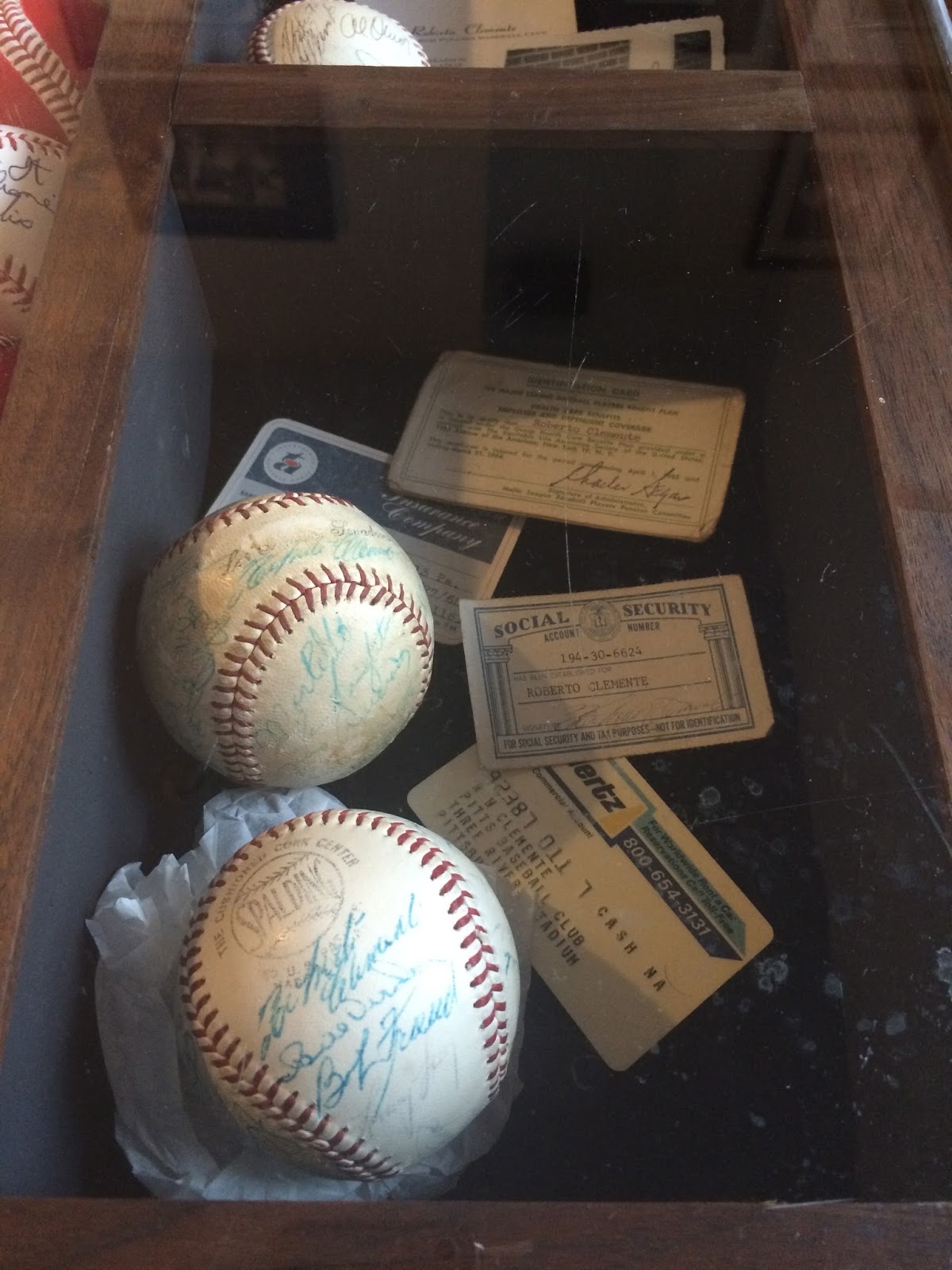
The next stop was the Clemente Museum. Executive Director and Curator Duane Rieder has meticulously renovated a historic firehouse to showcase the world's largest exhibited collection of artifacts which focus on Pittsburgh Pirate's legend and humanitarian, Roberto Clemente. Whether you know all about the man or nothing at all, the museum is one big reminder of how influential Roberto Clemente was for the game of baseball and both the Pittsburgh and Latin American communities.
| Factory 500 Members exploring Duane Rieder's collection of baseball memorabilia at the Clemente Museum. |
![]() |
| MF President & Co-Director, Barbara Luderowski taking a swing. |
![]() |
| Autographed baseballs, and Roberto Clemente's social security cards |
And to top off the night, Factory 500 members enjoyed a sampling of wines at Engine House 25, the winery in the basement of the Clemente Museum.
| Factory 500 members enjoying a sampling of wines in Engine House 25. |
A huge thanks goes to everyone who came out for this special Factory 500 event. Stay tuned for more information about our next membership event!
Factory 500 is the Mattress Factory's premier membership program, chaired by Susan Lammie. The group tours private collections, artist studios, local businesses, and other interesting arts destinations in Pittsburgh several times throughout the year. Don't miss out - Join today!
Categories:
FACTORY 500,
MEMBER PROGRAMMING,
MEMBERSHIP
Wednesday, July 15, 2015
RECAP // Mini-Factory: History!
In order for us to understand the present, we need to study the past. Mini-Factory tackled the topic of HISTORY. In essence, the past is a sequence of events which leads to the present. Our group of five-year-olds and their parents compared this idea to dominos; by standing up dominos in a line, we used our hands to make HISTORY and watch how events occur through time. Despite the challenges of keeping these skinny little rectangles vertical, our group of young artists caught on quick to the idea.
We followed up with a visit to Bill Woodrow's "Ship of Fools," an installation in the Mattress Factory's permanent collection at 1414 Monterey Street. It was so much fun to peer into this room of objects left stranded in the past. Cupboards are open, the paint is peeling, ... who lived here and used this space? What event occurred to make them leave? Even the light was left on as if the residents were in a hurry to leave. The objects give us clues about the HISTORY of this space, and the artists tells the story.
Mini-Factory is an interactive learning program for children ages three to five years old and their parents or caregivers. Using contemporary installation art, parents and children will explore new ideas and concepts from the everyday world. Join us at 10am on July 25 for FANTASY.
We followed up with a visit to Bill Woodrow's "Ship of Fools," an installation in the Mattress Factory's permanent collection at 1414 Monterey Street. It was so much fun to peer into this room of objects left stranded in the past. Cupboards are open, the paint is peeling, ... who lived here and used this space? What event occurred to make them leave? Even the light was left on as if the residents were in a hurry to leave. The objects give us clues about the HISTORY of this space, and the artists tells the story.
Mini-Factory is an interactive learning program for children ages three to five years old and their parents or caregivers. Using contemporary installation art, parents and children will explore new ideas and concepts from the everyday world. Join us at 10am on July 25 for FANTASY.
Tuesday, July 14, 2015
PREVIEW // ARTLAB: Summer in the Mattress Factory Gardens!
Recently in the garden: magic tricks during the Community Garden Party.
|
Winifred Lutz designed and built the garden installation from the rubble of the old paper factory, native plants, and boulders from the area, linking past and present, urban and natural landscapes. For our next ARTLab on Saturday July 18, we'll be enjoying our time in the garden and tapping into some summertime nostalgia with the following activities:
Make your own MAGIC POTION mixture with water, herbs, and special magic garden items!
MUD PIES! Make yourself or a friend a lovely muddy confection and decorate it with whatever you can find in the garden.
Make a newspaper sit-upon so you can sit wherever you'd like in the garden. At 3pm, we'll have an imaginary TEA PARTY and play some improvised tea party games.
It's summer, let's have some fun! And in the meantime you might uncover some fun hidden secrets that Winifred Lutz left in the garden.
As always, ARTLab is FREE with museum admission and is fun for all ages!
Monday, July 13, 2015
Take a piece of the Mattress Factory home with you!
![]() |
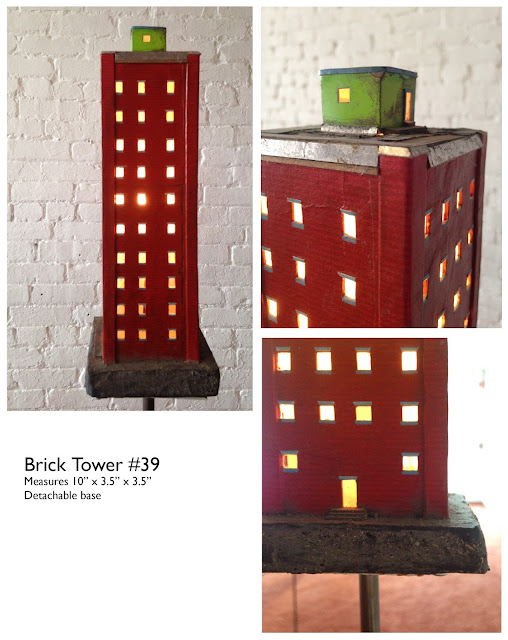
For more information about these works or to view additional pieces, please email shop@mattress.org or call 412.325.1512.
Don't miss this exclusive opportunity to take a piece of the museum home with you!
Subscribe to:
Posts (Atom)