Wednesday, October 21, 2009

LIKENESS Video Series: Paul DeMarinis

Today's installment in the LIKENESS Video Series (produced with love by MF Danny) comes from Paul DeMarinis, an artist who has been working in electronic media since 1971. Much of his work involves speech processed and synthesized by computers. In his LIKENESS piece, Dust, Paul utilizes a diverse selection of materials to create a unique and moving experience.


PAUL DeMARINIS
Dust, 2009 (4th Floor)
computer, video projector, photoluminescent powder, bass speaker
LIKENESS Exhibition - Through March 21, 2010

Paul DeMarinis has been working in the arts for several decades and subsequently has produced numerous performance works, sound and computer installations, as well as interactive electronic inventions. DeMarinis’s subtle and magical works display an intersection of tradition and progress, often motivated to cover an expanse of subjects and themes. Today we hear the term multidisciplinary! It is indeed an accurate one to describe Paul DeMarinis. Although the majority of his productions fall within the realm of art, he is also a historian, an experimenter, a chemist, a physicist, an engineer, a programmer, an inventor, a computer scientist and an archaeologist. His cross-disciplinary approach affords him an aptitude to condense the many facets of technology into his art constructions that aspire to be concurrently comprehensible and philosophical.

In his new work, Dust, DeMarinis explores facial similarities, pairs of faces, and the abstraction of images into the dust. DeMarinis presents a fragment of this collection of likeness-pairs, scanned sequentially into the light-memory of phosphorescent powder. After a few minutes of exposure to the projected image, the powder retains a faint green image of the two faces on its surface, something akin to the ‘latent image’ of photographic film or the veil of memory. Unlike photographic film, though, the image starts to distort. Propelled by low frequency sound vibrations, the powder starts to flow and dance, first distorting the faces and erasing their likeness, then distorting them into patterns of abstract light in motion, with form and beauty all its own. (Excerpt from Elaine A. King's gallery guide for LIKENESS)

Jeffrey POSTED BY JEFFREY
Read All Posts by Jeffrey

Tuesday, October 20, 2009

LIKENESS Video Series: Jim Campbell

Today's installment in the LIKENESS Video Series (produced with love by MF Danny) comes from artist Jim Campbell. Jim has two pieces showing in the LIKENESS exhibition, one of which you see below (Liz Walking: A Distillation Portrait) and the other will be posted here on the MF blog later in the week. Both make use of custom electronics and LED lighting. In Liz Walking, Jim has transformed an entire gallery into a lo-fi projection screen. To shine a bit more light on Jim's creative process, I've included some text from curator Elaine A. King's gallery guide below the embedded video.


JIM CAMPBELL
Liz Walking: A Distillation Portrait, 2009 (4th Floor)
custom electronics, LEDs
LIKENESS Exhibition - Through March 21, 2010

Liz Walking: A Distillation Portrait develops out of Jim Campbell's earlier Motion and Rest series that depicts six studies of people with disabilities walking. The idea underlying this series was that the low-resolution process inherently eliminates everything about the walking figures except for their gait. According to Campbell, "the works (or medium) distill the movement of the figures eliminating all of the other information from the moving images (age, clothes, gender, hair style etc. cannot be determined from the representations)."

This work goes further, when at times it eliminates the entire image including the movement such that only the rhythm of the movement is left leaving an even simpler representation. The installation is set up so that at the front of the room is a low-resolution image of the figure, but concurrently the two side walls (on either side of the viewer as they are looking at the front wall) have the same moving image presented in a great deal, lower resolution to the point of being almost totally abstract. However since the sidewalls are taken in with peripheral vision (which is also inherently movement based and more unconscious based) the rhythm of the figure is felt from the viewer’s peripheral vision as it is seen on the front wall with the observer’s direct vision. A unique situation is presented since the viewer’s peripheral vision is actually observing the same thing that the straight-ahead vision is seeing. Lastly, as a type of facilitation process for the viewer to leave their analytical seeing process behind, this installation goes through a cycle where the higher resolution image on the front wall gradually fades to nothing (a flat field) leaving only the peripheral image rhythm to be felt for a few moments before the front image gradually fades up again—what remains is a movement portrait or signature. (Excerpt from Elaine A. King's gallery guide for LIKENESS)

Jeffrey POSTED BY JEFFREY
Read All Posts by Jeffrey

Monday, October 19, 2009

LIKENESS Video Series: Tony Oursler

On Friday, October 9th, nearly 300 people packed into the galleries for the concurrent openings of LIKENESS, a group show guest-curated by Elaine A. King, and It's all about ME, Not You by Greer Lankton, which has been added to the museum's permanent collection. Big thanks to all who attended. I'm always amazed at the consistent outpouring of support at MF openings.

In anticipation of receiving and posting the official LIKENESS documentation images from our photographer, I'll be uploading short videos produced by Danny Bracken, multi-instrumentalist extraordinaire and MF Exhibitions Team member. First up in the series is Tony Oursler's Vampiric Battle.


On deck for tomorrow: Jim Campbell's Liz Walking (A Distillation Portrait)

Jeffrey POSTED BY JEFFREY
Read All Posts by Jeffrey

Thursday, October 1, 2009

Notes From the Archive: Greer Lankton


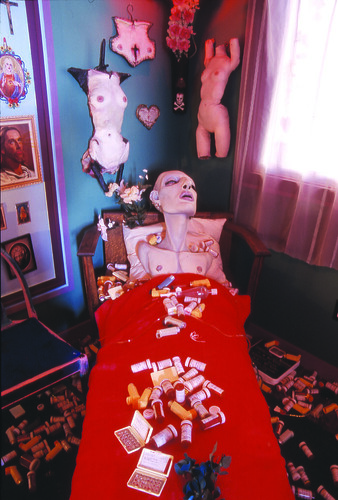
In 1996, the Mattress Factory had the good fortune to work with Greer Lankton as part of a group show that was guest-curated by Margery King. Greer's piece in that show, It's all about ME, Not You, was a large-scale recreation of her Chicago apartment/studio and housed dozens of the artist's hand-made doll figures, photographs, collectibles, and -- perhaps the focal point of the installation -- an addict in a bed surrounded by pill bottles. Shortly after the show opened, Greer Lankton passed away and upon the close of the show, we put the entirety of her piece in storage.

The Lankton Family has generously given Greer's final piece to the Mattress Factory and with the amazing help of several other supporters, we will be adding It's all about ME, Not You to the museum's permanent collection. The opening reception is next Friday, October 9th. You can RSVP and share the event with your friends over on FaceBook.

My role as archivist here at the museum involves documenting, preserving and cataloging artworks or, in most cases, artifacts of artworks. Because of the volume, diversity and fragility of the materials she used, Greer's piece has proven to be a labor of love for me. Many of her doll sculptures are made from delicate materials like toilet paper so implementing proper handling and preservation processes are very important.

And from an interpretive standpoint, this piece is dynamic to say the least. Curator Margery King states in her original exhibition essay:

When faced with the prospect of creating her first large-scale installation at the Mattress Factory, Lankton knew that she wanted to re-create her studio, in an ideal form, designing an environment of "artificial nature/total indulgence," filled with "dolls engrossed in glamour and self abuse." Like the artist herself, Lankton's dolls and environments possess a disarming mix of innocence and decadence, hope and pathos. She said her work was "all about me," reflecting her life as an artist, a transsexual, and a drug addict. But beyond this, from her position as an outsider, Lankton eloquently explored and questioned accepted norms of gender and sexuality, as well as the powerful imagery of popular culture and consumerism. Her work also describes the difficult mandate of these pervasive, seductive models and the pain of those who do not conform. It is tempting to think that Lankton created her installation at the Mattress Factory as if she knew it was her last (she died in late November, a month after the exhibition opened), filling the space with a retrospective selection of her beloved dolls and everything that was most meaningful to her.

In this video, shot at the 1995 Whitney Biennial, Greer talks about two of her sculptures: a bust of Candy Darling and one she calls Blue Babe. The audio and camera quality are a bit shaky, but it's really great to hear the artist herself speak about these works. A great moment comes at 1:06 when a gallery attendant tells Greer not to touch the art and she says simply, "It's mine!" Coincidentally, this Candy Darling sculpture is now on view as part of It's all about ME, Not You.


Speaking for all of us here at the Mattress Factory, we feel very lucky to have the ability to show It's all about ME, Not You permanently. Greer's work has touched many people's lives over the years and we look forward to helping enable that connection for new generations into the future.

Leah POSTED BY LEAH
Read All Posts by Leah

Tuesday, September 22, 2009

PodCamp Pittsburgh 4


One of the most unfortunate occurances for me last year was being out of town during PodCamp Pittsburgh 3, which took place in October of 2008. Well, lucky for me (and hopefully you!) PodCamp Pittsburgh 4 is coming up in a just few short weeks (October 10 + 11). For those of you thinking, "Pod-what?," PodCamp is a FREE community UnConference, run by and for people who create, enjoy, or are interested in learning more about social media.

This year’s PodCamp Pittsburgh is bringing an exciting crew of social and new media makers to our city. Topics range from beginner-level to advanced, and cover a wide variety of learning sessions for writers, bloggers, vloggers, web developers, web designers, podcasters, business owners, job seekers and anyone interested in learning more.

And what a great surprise to learn a few weeks ago that I'll be presenting two sessions, "myG20: Bringing Anarchists and Business Professionals Together Since 2009" on Day 1 and "Friendship 2.0: Community Building for Non-Profits" on Day 2. Check out the amazingly awesome two-day schedule in its entirety HERE.

Also, big props to @Sorgatron and @allthingsnoisy for coming over and shooting this video spotlight highlighting some of the new media projects we have cooking here at the MF:


So what are you waiting for? Hop to it. Registration is FREE and easy. I hope to see you there!

Jeffrey POSTED BY JEFFREY
Read All Posts by Jeffrey

Monday, September 21, 2009

GUEST POST: First-Hand Accounts of Revolution


The following is a guest post from S.E. Adkins, a North Side neighbor & consultant who draws on her diverse experiences and accumulated knowledge to help small businesses, non-profits, and individuals. Please join us and City of Asylum/Pittsburgh Wednesday evening for a screening of Burma VJ.

The film Burma VJ, by Anders Østergaard compiles smuggled footage from individuals using handicams on the streets of Myanmar to tell the larger story of the so-called Saffron Revolution. In Burma, called Myanmar by the ruling military junta, a disproportionate amount of national income is spent on the armed forces. Living in one of the 20 poorest countries in the world, ordinary Burmese citizens live on little income while the costs of basic commodities such as rice and eggs continue to rise. In February of 2007, small groups began peacefully protesting the state of consumer prices. The protesters, including the monks, were dealt with brutally. Arrests and killings became a hallmark of the military junta’s response to such protests. The video journalist (the VJ in Burma VJ) became revolutionary in their witness of these events. The videos would reach back into Burma by satellite, and were available for international media use. As foreign media is banned, this is even more crucial.

Burma VJ Screening at the MF -- 9/23

Burma continues to be a topic of wide global importance, underscored by the more recent news stories regarding the imprisonment of Aung San Suu Kyi and the government’s negligence of its people following Cyclone Nargis. The people have very little civil and personal freedoms. City of Asylum/Pittsburgh knows first-hand about this, with their mission being to provide sanctuary to writers exiled under threat of death, imprisonment, or persecution in their native countries. The current writer-in-residence is Khet Mar, herself from Burma. She is a journalist, novelist, short story writer, poet, and essayist. She and her husband, Than Htay, a visual artist, are working together to create a mural representative of their story and the intersections between Burma and Pittsburgh.

There will be a film screening of Burma VJ at the Mattress Factory on Wednesday September 23rd at 7:00 PM, followed by a reception and Q&A with a monk from the Saffron Revolution. The next day, Thursday September 24th, at 9:00 AM a press conference will be held at City of Asylum/Pittsburgh with writer-in-residence Khet Mar and Burmese monks. This is a unique chance to meet Burmese monks from the frontline of a revolution, and to learn more about City of Asylum/Pittsburg’s newest writer-in-residence, Khet Mar. I hope to see you at one of these special events!

Reservations are FREE, but must be made in advance by calling 412-321-2190.

Thursday, September 10, 2009

Do-It-Yourself QR Codes: A 4-Step Guide


Approximately one year ago, the Mattress Factory began experimenting with QR (or Quick Response) codes and this past April the museum became the first in the United States to utilize the technology on-site as a visitor engagement tool. More on that HERE. Our use of QR Codes in the galleries has been getting some attention (1,2), and I've fielded numerous inquiries from artists and arts organizations wishing to utilize this technology in their practice or operations.

One can only presume that, as 2D barcode technology continues to evolve and becomes more accessible to more people, more artists and arts orgs will want to utilize it. And on the heels of that interest comes people and companies that will attempt to capitalize from providing clients with an essentially open (read: FREE) technology. So, in an attempt to save our fellow artists a boat-load of money, we decided to publish a step-by-step guide for those who wish to experiment with QR code technology. No consulting firm needed. Please keep in mind that this is only how we here at the MF implemented the codes. If you think there are better ways, or workarounds, please share in the comments to the post.

STEP 1: Upload Killer Content (IMPORTANT!!)
Give people or visitors a reason to open the codes. The codes we place throughout the galleries contain link to mobile browser optimized (JI - 9/15/09) rich multi-media content that provides context or backstory to the artworks we exhibit. We upload video files to YouTube, behind-the-scenes still images to Flickr, and informative text-based PDF files, all of which are supported by QR code technology accessible via most mobile platforms (JI - 9/15/09). Universal codes that access a stagnant website may prove to be less interesting to your audience.

STEP 2: Generate the Codes
Once you have developed the content you wish to share with your audience, it's time to make the codes. We use a very simple web generator provided by Kaywa. This generator is nice because it provides output & resolution options. If you're creating a print piece, you can select the extra large file output which optimizes quite nicely for signage.

Because the density of information contained within a code can effect its readability, we shorten all URLs with http://bit.ly. This may seem like a frivolous extra step, but it greatly impacts the ease with which our codes are read. Below are two codes that open the same URL. The URL embedded in the less dense code on the right has been shortened making this code easier and more consistently read.


STEP 3: Place or Hang Codes In Desired Locations
Once we generate our codes, we design the signage and collateral materials that will hold them. Codes can be displayed and read in hardcopy or electronic (screen) format. The only obstacle we've experienced has been customizing the size of the codes. Ideally, we'd like the codes to be smaller (i.e. 3/4" x 3/4"), but the smallest we've been able to go with consistent readability has been 1.5" x 1.5". As QR technology and hardware progresses, I anticipate the ability to reduce code sizes will emerge in the near future.

Mattress Factory Museum
Mattress Factory gallery card containing a QR code.

STEP 4: Introduce the QR Codes to Users in a Non-Intimidating Way
Let's face it. The unknown scares people. And new technology has a way of intimidating potential users. We knew going into this that it was imperative to present the codes to visitors through technology they were already familiar with. We started by hanging several "This is a QR Code" signs in the museum lobby and elevator. These signs contain a short description about what the codes are.

We knew visitors would have more questions about the codes that would be impossible to answer through signage, so we created a simple text message (SMS) info relay. Through TextMarks, an inexpensive and easy SMS shortcode provider, visitors who send the keyword QRCODE to TextMarks' shortcode receive an immediate reply containing two links. The first link directs the user's mobile phone browser to a site that detects what type of phone they're using, provides more information, and a FREE download of the appropriate code reading application.

The 2nd link directs iPhone users to App Store, where they can download the most current FREE version of the BeeTagg Multicode Reader. There are numerous barcode reading applications available on most mobile platforms, but we recommend BeeTagg because of it's universality across the spectrum. In fact, factory-installed readers are now common on many phones including Nokia devices and the G1 Android. This SMS information relay has proved to be a vital piece to our QR code puzzle and has served those visitors curious about the technology greatly.

QR CODE WRAP-UP
So this is what worked for us. I'm interested to hear if other organizations find this information useful and beneficial. For further reading about QR codes in a museum setting, check out how the Powerhouse Museum in Australia has been using them. If you have further questions or a tip that might help others to implement innovative use of QR codes, feel free to leave a comment. If you'd like to hit me up off-line, shoot over an email or track me down on Twitter.

Jeffrey POSTED BY JEFFREY
Read All Posts by Jeffrey