Wednesday, July 24, 2013

Richard Morris Used to Live in Our New Gallery Space


516 Sampsonia Way, our soon-to-open 2,500 square-foot exhibition space, was a rental property from the late 1800s until the 1980s. While Molly Tighe, our archivist, was digging through historical documents to research the building, we were contacted by Richard Morris, whose family lived in the property from 1934 until 1963. Morris was a wealth of information, and provided stories and pictures about life in the North Side at the middle of the century. Since his stories give such a great sense of space for the building and resonate so well with the themes of our opening exhibition there—Chiharu Shiota: Trace of Memory—we decided to make a video, and let Morris take you through a virtual tour of the building before it opens on September 12th. Enjoy!


--Posted by Matthew, marketing intern

Friday, July 19, 2013

COMMUNITY ART LABS: WHAT THE KIDS HAVE TO SAY

For the past two weeks an enthusiastic bunch of students have taken up their own artist residence at the Mattress Factory for Community Art Labs. Pittsburgh puppet maker Cheryl Capezzuti has been working with a group of 10 to 13-year olds to transform both every day and unusual materials into one-of-a-kind creatures and full-body puppets.


Artist John Peña has been guiding students through various stages of sculpture, from miniature to massive! 


You can see more pictures of Community Art Lab on our Flickr page.

As today is the last full day of workshops for our first session, Director of Education Felice Cleveland sat down with the young participants to hear what they had to say about the Mattress Factory and their workshops. Some of the best responses are below:


Do you know what installation art is?
-Yes, art you can walk into –  a place that you can actually live in.
-Yes, art that you can get into – inside of it and connected with it.
-Yes, art that makes use of space or that you can be inside of.
-Yes, when art is made in the space and it is IN the space.
-Something that is creative and can use any material, anything you can imagine.


What have you learned at Community Art Lab?
-That you never make mistakes in art, even if you mess up to keep going
-How to work better with other people, work more quickly and execute an idea faster.
-That there is art that stands out and art that doesn’t. I learned that "ephemeral" is something that lasts for a very short time.
-Art isn’t just painting and sketches. You don’t need anything fancy to make art (i.e. we are using a lot of cardboard!).


What was your favorite activity at Community Art Lab?
-Making the project where something fits in your hand five or ten times bigger.
-Making small and big puppets – it was very artistic and we used recycled materials. Working together on one project but trying different materials. 
-Giant puppets and making giant things.


How did you like being at the Mattress Factory all day?
-I like it, it's fun and different. I’ve never been to a camp with so many activities and you actually get to go outside and eat lunch in a piece of artwork.
-I like it a lot. I like the atmosphere of both classes. It is happy like a family.
-I LOVE it, because it is fun and creative and you get to not just look at art, but go in to it.


How does Community Art Lab compare to other programs you have participated in?
-It is more exciting here and you get to do everything.
-It is better than others, you can make so many things with all your teachers and it is so fun.
-Everyone is treated the same – both adults + kids. There is a better quality of art/materials.
-This program is a lot more work—more collaborative.
-It is a museum and it is a lot of art – there are better and more interesting projects at CAL. Other
camps have projects I already know and something I don’t know is more interesting.
-All other programs were science / math, so this was more creative and laid back. There were no wrong ideas for projects.


What improvements could be made to Community Art Lab?
-Longer – having more weeks.
-Longer days.
-We could add more weeks and have more activities and different artists come.


Do you have any other comments?
-The Mattress Factory is awesome.
-I think that there is a good amount of staff who were all very charismatic and I’m glad they had air conditioning.


All of the students involved in this summer's Community Art Labs will take part in a celebration August 9 from 6-8pm. Come check out what all the budding artists who participated in our workshops have been up to this summer. Invite your friends to come with you and see incredible artwork (both in our permanent collection AND made by students) and never-before-seen performances, participate in hands-on workshops and enjoy light fare. Free; RSVPs requested to felice[at]mattress[dot]org.

Thanks to all of our 2013 Community Art Lab participants. We're glad we have air conditioning too!


Mandy POSTED BY MANDY
Read All Posts by Mandy

Monday, July 15, 2013

FEMINIST AND . . . IN RETROSPECT

During the last week of the installation, Feminist And..., we detailed our intern Matthew Liner to document some of the works for our blog. Matthew dug deep and spent time in each of the spaces to share them in his own words. Below are his interpretations of works by Parastou Forouhar, Loraine Leeson and Carrie Mae Weems.


Feminist And…Orientalism: 
The Work Of Parastou Forouhar


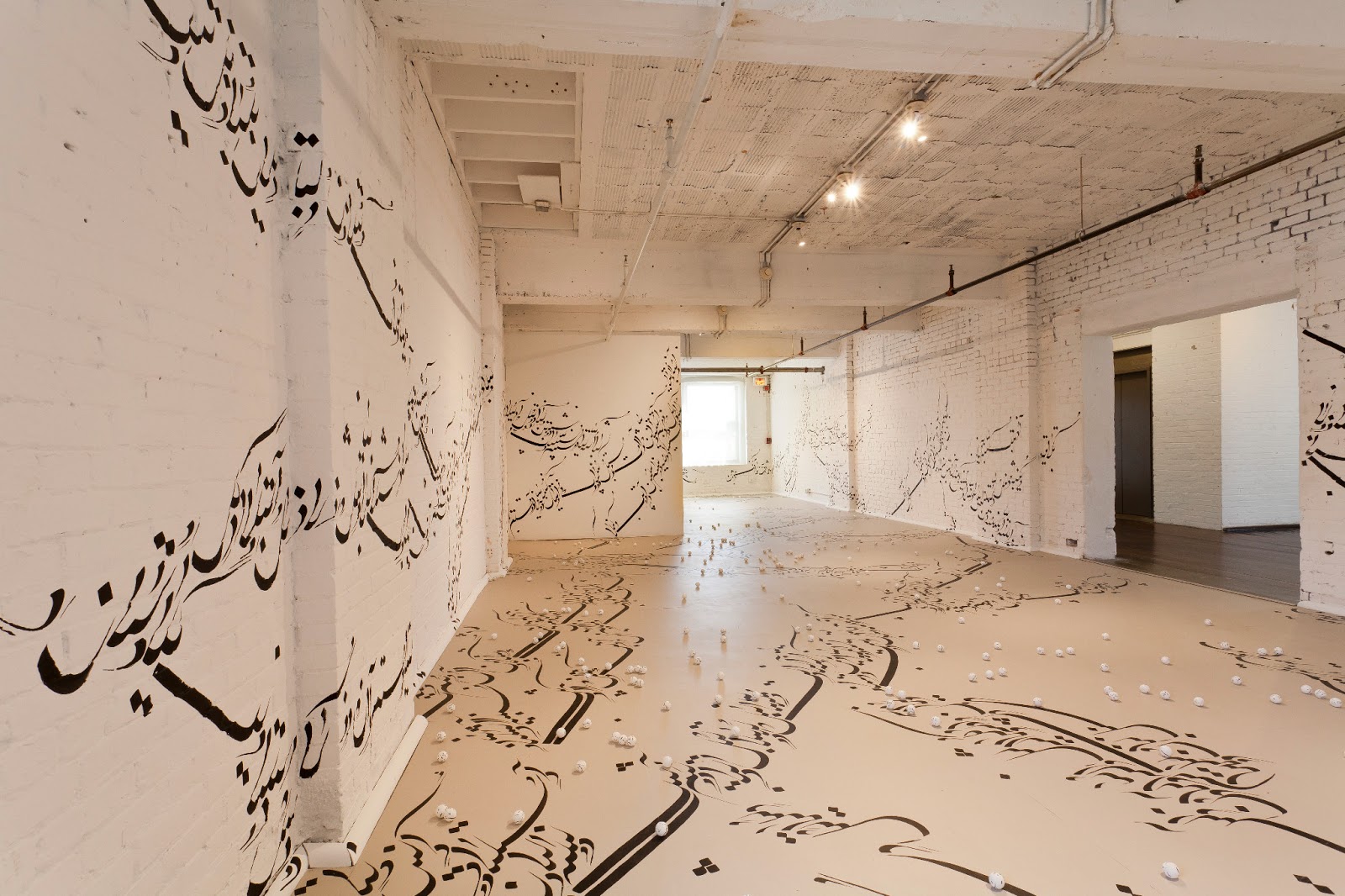
Parastou Forouhar’s Written Room defies traditional boundaries of architecture. The walls and floor are covered in an ornamental Farsi that branches and sweeps over the white of the room. The writing does not obey the “up-down direction” that Forouhar attributes to architecture. Instead, she reimages the space as a place where her language fails in everyday life, separating her from both the Western culture that sees her home as an “alien society” and the native Iran that rejects her beliefs.


Through her illustration, animation, painting, and sculpture, Forouhar observes how we, as Westerners, observe “Oriental-Islamic” culture. To the average Western viewer, the writing on the walls of Written Room is indecipherable. The Persian language becomes pure ornamentation: a beautiful script that simultaneously alienates and contains its audience. The cultural gulf created by the disparity between languages separates the audience from what surrounds them. They can find no beginning, no end, and no words for interpretation. The effect is that of expatriates in a foreign country: thrust into a new culture and forced to give up an authoritative standpoint, isolated by what surrounds them.


However, Forouhar complicates her work. The Farsi on the walls only offers snippets of phrases and words, leaving the piece broken and obfuscated to even those who can read her writing. The choice to further the distance between the audience and the artwork hints at the beginnings of the project as it relates to the identity of an expatriate, distanced from both the culture she’s in and the culture she’s from.


Forouhar’s parents were assassinated on November 21, 1998. Her parents, Dariush and Parvaneh Forouhar, were the first of the “Chain Murders”—political murders of the Iranian government’s opposition. A year later, Forouhar began her Written Room project, building a body of work that explores national identity from a country known for political prosecution of women and activists.


Since the deaths of her parents, the Iranian government has challenged Forouhar at every attempt to memorialize her parents’ deaths. Most recently, in November of 2012, she was stopped and had her passport confiscated upon entering the Iranian airport. Her precarious situation makes obvious the dilemma of the expat existing between a cultures that misunderstands and a culture that rejects.


You can view more of Forouhar’s work, as well as read her essays on her website.


Feminist And…Community Perspectives: 
Loraine Leeson’s Active Energy


“If there were any technology that could be developed that you feel would best support yourselves or your communities, what would that be?”


Loraine Leeson's art practice revolves around the above question. Through her work, she’s helped raise awareness for a variety of issues, bringing communities together around a single cause. Her community-centered art has worked to benefit communities for the past 30 years. In the 80s, Leeson co-founded the Docklands Community Poster Project, which ran during the ten-year re-development of the London Docklands. In 2002, she founded cSPACE, a website dedicated to the exploration of collective creative practice.


In 2008, Leeson began Active Energy, a series of interviews with the Geezers Club in London’s East End. This project has Leeson directly asking her subjects what technology they thought would support their community, and the group banded together in answering the question with a concern about alternative energy in the Thames. Since, the group has made a proposal to install turbines in the river.


Bringing the project to Pittsburgh with the Mattress Factory, Leeson posed the same question to a group of senior North Side women, and they answered with their concerns about Alzheimer’s. The videos of the interviews, exploring their concerns about dementia and aging, are paired with those of the Geezers in London. Outside the viewing room, a small table and video station offer an interactive segment of the piece, where viewers can watch more in-depth interviews, as well as find out more about the project. The effect of the piece is a cacophony of voices, blending concerns of mental and environmental health from both sides of the Atlantic, and connecting with Betsy Damon’s addition to the exhibition.
           

Find out more about Loraine Leeson’s work at the Active Energy website and join in on the conversation in the comments below. What technology do you feel would best help the local community?


Feminist And…Pepper’s Ghost: 
Carrie Mae Weems’ Lincoln, Lonnie, and Me


What do Carrie Mae Weems and Tupac Shakur have in common?


They’ve both taken the form of Pepper’s Ghost.


Carrie Mae Weems’ installation at Mattress Factory (which recently traveled to the Look3 festival) builds on an already diverse body of work that examines the legacies of racism, sexism, and classism in American culture through far ranging media. For her piece at the Mattress Factory—Lincoln, Lonnie, and Me – A Story in Five Parts—Weems skews the use of film in a way only she can, by conjuring up Pepper’s Ghost., a technique with roots in the 16th-century that still wows audiences today.


In the late 16th-century, Neapolitan scientist Giambattista della Porta set down instructions for an illusion titled “How we may see in a Chamber things that are not.” The instructions, which describe using a polished glass pane to reflect objects completely outside the audience’s field of vision, are (according to Wikipedia) the first description of Pepper’s Ghost.

Fast-forward to 1862, and the inventor Henry Dirks has developed a theatre spectacle known as the Dirksian Phantasmagoria, an update to the illusion that fills an entire stage.  Dirks’ technique proved too costly for theater owners to support, since the entire stage needed to be rebuilt for his effect to work. So, John Henry Pepper, a scientist and inventor with The Royal Polytechnic Institute in London, popularized a modification of Dirks’ technique that was cheaper. Pepper’s name was permanently tied to the technique, although he did try to give Dirks credit.

Since its popularization, the technique has been used by everyone including amateur haunted house builders to the team that brought Tupac Shakur back to life at Coachella 2012.


Weems uses the illusion to great effect, capitalizing on the ethereal quality of Pepper’s Ghost to show how the history of race, gender, and class in America still haunts our culture today.


-Posted by Matthew, marketing intern

Wednesday, July 10, 2013

ONCE UPON A MATTRESS: WORKING "AS AN ARTIST"

As we discovered in our last post from the MF Archives, James Turrell's 1983 exhibition at the Mattress Factory marked a significant turning point for the museum, which until then had only exhibited works by local artists. Though the museum's exhibition program has grown to include works by artists from over 25 countries, many aspects of the early life of the Mattress Factory remain unchanged. In particular, I find it fascinating to look back and reflect on the museum's long-standing dedication to maintaining a creative workspace for artists. Ever since the very beginning, co-directors Barbara and Michael have encouraged artists to experiment with their craft, unencumbered by deadlines or commitments, and with the undivided support of the entire museum staff.

James Turrell planning his installations at the Mattress Factory, 1983


James Turrell's month-long residency was a flurry of activity. He worked alongside the construction crew, drafting and re-drafting plans, hanging drywall, and experimenting with a variety of effects until he was satisfied that his vision had been realized.


James Turrell planning and re-planning his installations, 1983

In November 1983, Turrell described his Mattress Factory residency as providing the time to take risks and explore far more possibilities within a space than he expected in a standard museum setting. He described the experiences as allowing him to "work as an artist," making messes, changing plans last minute, and allowing the artwork to evolve and develop through the creation process.[1]


James Turrell working "as an artist."

The 1983 Mattress Factory presentation of James Turrell works was a part of, Urban Pulses: The Artist and the City, a cross-institutional, city-wide exhibition heralded as the most significant expression of contemporary art in Pittsburgh in decades.[2] Over the course of several months contemporary art heavyweights Keith Haring, Jenny Holzer, Paul Thek, Gilbert and George, Romare Bearden, Roger Welch, Ed Paschke, Michael Smith, David Wojnarowczs and others filled gallery spaces across the city, offering varying takes on notions of urbanity, expression, and the grit of the city life.

Without a doubt, the most lasting work from this intensely vibrant period in the Pittsburgh art scene are the two Turrell works created during his residency, Pleiades and Danaë. We'll look closer at these works and learn about how they came to stay at the Mattress Factory in our next post.  


[1] Mattress Factory.  1983 Programs Completed Report.  Artists Files Collection. Mattress Factory Archives, Pittsburgh, Pennsylvania. 


[2] Miller, Donald. "Most significant art show since 69." Pittsburgh Post-Gazette 22 October 1983: 21. Google News Web. 17 June 2013. 


Molly POSTED BY MOLLY
Read All Posts by Molly


Friday, July 5, 2013

2013 URBAN GARDEN PARTY WRAP-UP


2013 URBAN GARDEN PARTY
SOUL FACTORY: MOTOWN AT THE MUSEUM

Friday, June 21, 2013
 
This year's Urban Garden Party was again a sold-out affair, with nearly 1,400 guests flocking to the North Side to get down in support of Art You Can Get Into. The event raised an unprecedented $265,000 for the museum's artistic programs, educational outreach and operations. Following the fundraiser, over 400 people attended Community Garden Party for art activities, performances, workshops and fun! Click here to view pictures from this year's party.

GENERAL ADMISSION 7-11PM | SOLD OUT
VIP 6PM | SOLD OUT
Go back to a time when clothes were a little flashier, hair was a little funkier and 45 rpm was the only speed in town. Marking the museum's 35th year in Pittsburgh's North Side and looking ahead to our fall exhibition, Detroit: Artists in Residence, the Mattress Factory presents Soul Factory: Motown at the Museum. Co-Chairs Anne + Anuj Dhanda invite you to groove on over in your hippest rags for the museum's annual fundraiser, headlined Vancouver-based DJ The Gaff. This year's funk fest will feature over 40 of Pittsburgh’s best restaurants and caterers, pop-up performances by live entertainers including Kierra Darshell's Divas of Drag and DJ Zimmie, a silent auction of one-of-a-kind artwork, a Motown photo booth and dancing. A VIP pass will open the doors to the exclusive VIP pre-party from 6 - 7:30pm, hosted by Bob Sendall of All in Good Taste and featuring signature cocktails poured by Tender and Verde with Wigle Whiskey and Clique Vodka. Title Town Soul & Funk Party will provide Motown sounds from the 60s and 70s on original 45s and a private performance by Kierra Darshell's Divas of Drag will open the floor for you to shake your own groove thang in our Soul Train dance-off. Your VIP pass also gets you access to the VIP Lounge--including exclusive entertainment, a private bar, restroom and courtyard for VIPs only--throughout the night.

SOUL FACTORY AFTER PARTY
After the excitement dies down at MF, slide on over to Penn Brewery at 800 Vinial Street for the official Soul Factory after-party! All party attendees are invited to the after party, so SAVE YOUR WRISTBANDS for exclusive drink specials, a DJ and more. Check back for details as they are confirmed!


SOUL FACTORY CO-CHAIRS
Anne Nemer Dhanda + Anuj Dhanda

SOUL FACTORY HOST COMMITTEE
Mary-Lou Arscott
Christine Astorino
Judith Berger
Molly + Peter Blasier
Jessica + Jeff Brown
Pamela Z. Bryan
David Bush + Tim McVay
Lalit + Supriya Chorida>
Dan Drawbaugh + Sarah Thomas
Sherry DuCarme + Jeff Crummie
Rich + Cindy Engler
Peggy Finnegan
Beth Ann Fuhrer
Bryan Garlock + Deb Bergren
Paul J. Gitnik
Bob Hoover + Kathleen DeWalt
Rick + Laurie Johnson
Ryan Lammie
Susan + Scott Lammie
Jacqui + John Lazo
Martin Lazor + Karen Fredette
Scott Leff + Marilyn McDaniel
Helene + Tom Long
Muriel Luderowski
Ellen Mazo
Annie O'Neill
Nancy + Woody Ostrow
Councilman Bill Peduto
Terry + Tracey Perles
Donna + John Peterman
Marirose + John Radelet
Frances + Smokey Robinson
Caryn Rubinoff + Craig Dunham
Sharon Semenza + Bill Robinson
Dmitri + Ann Shiry
Rosanne Silva + Michael Tonkin
Eric Smith
Gene L. Svrcek
John Verbanic
Anoo + Viju Verghis
Alan + Martina Wells
Eric Werner
Michael White + Rick LeBeau
Maureen Young
Mazen Youssef + Suzan Obagi

SOUL FACTORY SPONSORS

$15,000
UPMC + UPMC Health Plan

$10,000
Anonymous
AT&T
CA Technologies
CGI
EMC
IBM
Oracle
Tata Consultancy Services

$5,000
Avaya
Cisco Systems
ConsultUSA
Highmark Blue Cross Blue Shield
NACR
PNC Bank
PPG Industries Foundation
Presidio
Visa

$2,500
Allegheny General Hospital
Anne + Anuj Dhanda
H.J. Heinz Company
National Financial, A Fidelity Investments Company
The Pittsburgh Steelers
Schell Games
Xerox

$1,500
Plastic Surgery of Pittsburgh

$1,000

41st Parameter
Amcom
Gartner Inc.
Institute for Entrepreneurial Excellence, University of Pittsburgh
KPMG
Susan + Scott Lammie
Marilyn Coleman Consulting
Radiant Hall Studios

SOUL FACTORY MEDIA SPONSORS
WHIRL
Yelp
Pittsburgh Post-Gazette
90.5 WESA + 91.3 WYEP

SOUL FACTORY FOOD + BEVERAGE SPONSORS
2 Local Girls
All in Good Taste Productions
Atria's @ PNC Park
Bar Marco
Bean Catering/Just Bean Coffeehouse
Big Boss Ice Cream
Bluebird Kitchen
Clique Vodka
Coca Cafe
Diageo-Guinness USA
Divine Delectables
Donato's Restaurant
Double Wide Grill
E2
Eclipse Lounge
Enrico's Biscotti Co.
Erin's Fine Foods
Fukuda
Gina Marie's Catering
Girasole
Half Baked
Jimmy Wan's Restaurant and Lounge
JPC Event Group
La Prima Espresso Co.
Legume
Lola Bistro
Luma
Marty's Market
Monterey Pub
Ola Appetit Catering Company
Opening Night Catering
Penn Brewery
PGH Taco Truck
Pittsburgh Candy Buffet
Pittsburgh Winery
PVI Global Imports
Rania's Catering
Rita's Italian Ice
Tender
The Capital Grille
The Culinary Artists Gourmet Catering Group
The Elbow Room
The Grateful Deli
The Greek Gourmet
Tupelo Honey Teas
Verde
Wigle Whiskey


FRIENDS OF THE MF
17th Street Cafe
ALCO Parking Corporation
Flowerama
Hilbish McGee Lighting Design
J.V. Chujko
Massage Envy Spa - Squirrel Hill
Mistick Construction Company + Northside Associates
Nakama
Party Savvy
Shults Ford


ADDITIONAL THANKS


VIDEO CREDITS  
The Gaff and Skratch Bastid: Good Old Days Pt. 2           
The Gaff: Do That Thing          
Girl Talk: This is the Remix 
Love Skateboards: Rob Mentov and Justin Bohl: Nothing Stops Detroit
The Best of Soul Train

Friday, June 28, 2013

Soul Factory: Motown at the Museum -- A HUGE success!

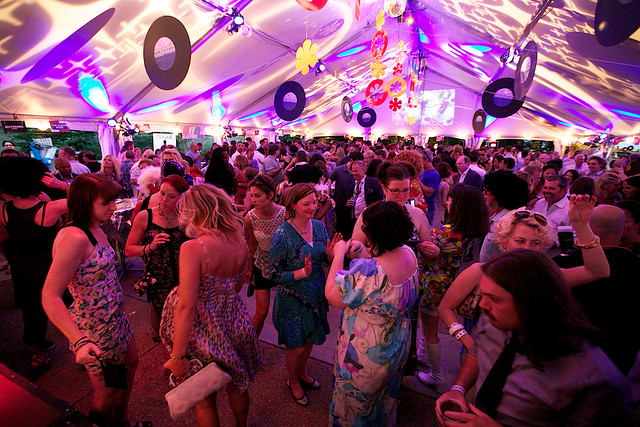
Nearly 1,400 party-goers boogied into the night under the main tent at the 2013 Urban Garden Party.
Photo by Bridgett Kay Photography

Last Friday night nearly 1,400 people turned out to make merry and boogie down on the North Side. The tent was rocking and the garden was packed! Mash ups by The Gaff and DJ Zimmie soared through the balmy air and hoards of Pittsburgh's grooviest art supporters shimmied and shook into the night. After tallying up all of our ticket sales and sponsor pledges, we brought in a whopping $260,000 for the museum. That is the most we've ever raised in the Urban Garden Party's 16-year history, and it's all thanks to you!

Some of the coverage we have received to date:

"Its reputation preceding itself, the 2013 Urban Garden Party lived up to all expectations by unleashing a torrent of glorious celebration that left its mark on 1,300 who traded convention for a night unlike any other." -Kate Benz, Pittsburgh Tribune-Review

"So began an evening that is the envy of every nonprofit in town, a bash that's pure fun and still made $250,000 thanks to chairs Anuj and Anne Nemer Dhanda." -Marylynn Uricchio, Pittsburgh Post-Gazette

WPXI's See and Be Seen, Urban Garden Party held at Mattress Factory


Mattress Factory Co-Director Barbara Luderowski, Chairman of the Board Michael White and Co-Director Michael Olijnyk

Our photographers were roving the party all night and we're uploading pictures to Flickr as we get them. We would also love your submissions to our group pool with the tag ugp2013. Or tweet your pics to @mattressfactory using #soulfactory. If you had your picture taken in our photo booth at the party, your pictures are here.


Finally, a big heartfelt Mattress Factory THANK YOU to our co-chairs Anne + Anuj Dhanda. We could not have thrown the hottest party in Pittsburgh without the help of our co-chairs, who not only know how to steer a party-planning committee, they also know how to get down! We are so grateful to the Dhandas and all of our sponsors for their incredible support this year. Make sure to help us thank our sponsors by seeking them for any of the professional services they provide. 

Party co-chairs Anuj (left) and Anne (right) Dhanda shake it with a go-go dancer

Keep an eye out on our website for the announcement of next year's Urban Garden Party date!
 
Mandy POSTED BY MANDY
Read All Posts by Mandy

Thursday, June 27, 2013

GardenLab@510


As Pittsburgh moves into warmer and sunnier weather, consider visiting one of the Mattress Factory's outdoor projects: Rose Clancy's GardenLab@510. This summer marks the fourth year that Clancy has worked with abandoned sites neighboring the Mattress Factory. GardenLab@510 is the second of two reclaimed spaces that Clancy has used to explore the relationship between neglect and nurture. Clancy experiments using aspects of archeology, gardening, sculpture, and her personal history. In the spirit of the Mattress Factory's focus on how a site influences how an artwork is developed, Clancy reflected on how her more recent GardenLab@510 has evolved:

Originally, the GardenLabs project began when I transplanted potatoes from a former project to 516. Once GardenLab@516 ended, I made elements of that project portable and moved them to 510. During GardenLab@510's first year, I observed the natural conditions of the site and then worked with those conditions to maximize the success of a garden in that space. I also kept some of the elements that already existed in that space: some plants and some man-made items. In contrast to 516, the garden at 510 is not completely enclosed. This has allowed for more community access: there have been tours, an ArtLab performance with children dressed as bees, and many impromptu conversations with neighbors passing by. As this became apparent to me, I wanted to show appreciation to my neighbors so I grew communal herbs. This year's focus at 510 is on the garden as a studio. I'll be making work in a bean house that will house a workbench. Some of the work that I make could make its way back into the community...

Clancy works with aspects of gardening, but she does not consider herself a gardener. She makes choices in her GardenLabs primarily on how: elements can be metaphors for her personal history, how plants respond to being neglected or nurtured, and also how the community responds to the plants and overall project. While Clancy highlights the conceptual aspects of her GardenLabs, she recognizes that she is working with actual plants in a real neighborhood and that she must be sensitive to how this ecosystem evolves. Her choices affect nature and the neighborhood, and their evolution affects the practical and conceptual choices in her artmaking. Clancy invites visitors to stop by anytime, but encourages people to make more than one trip since the space changes so much from week-to-week.

Check out images of GardenLab@510 on Rose Clancy's Facebook page.